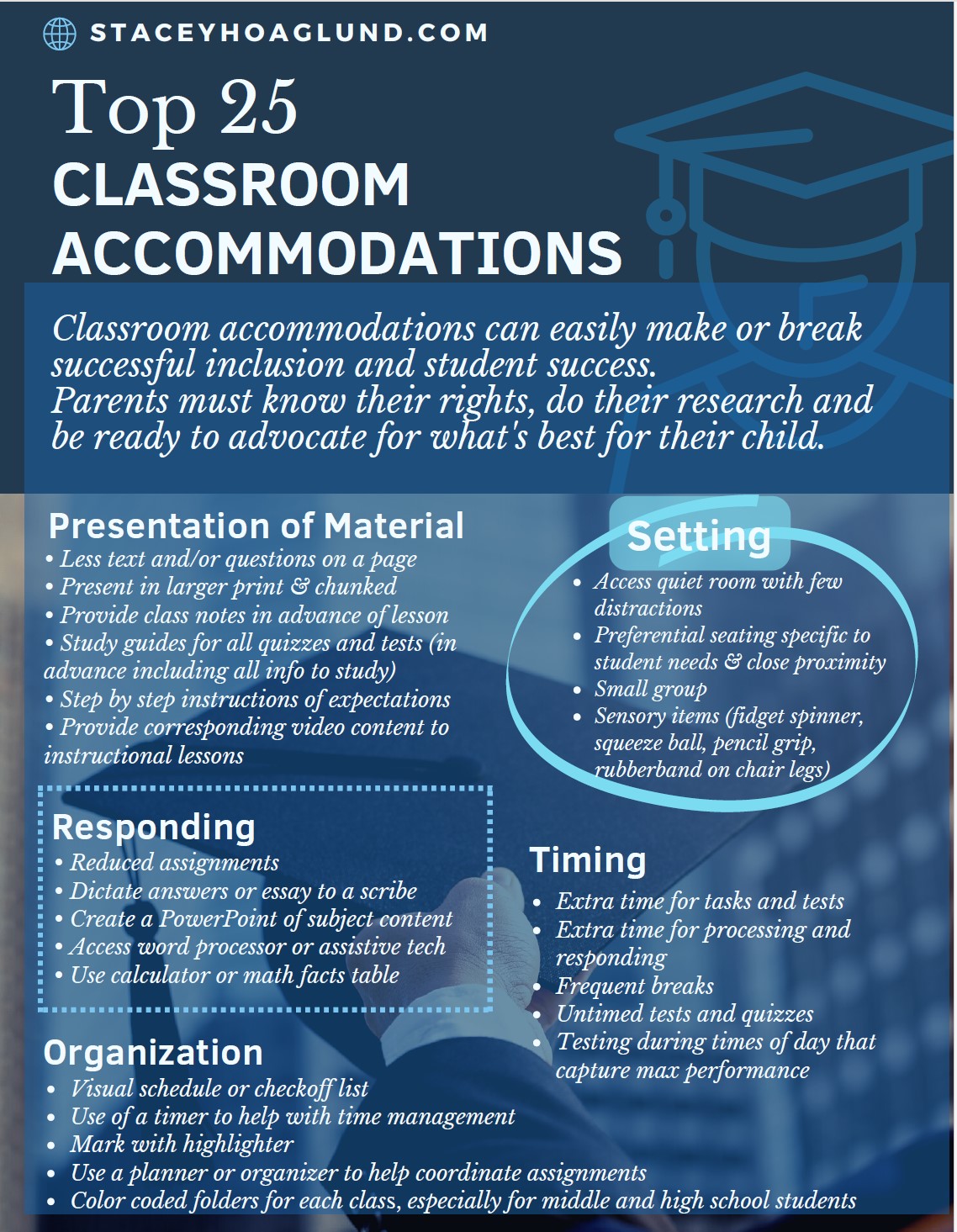
Each year when you have your child’s annual IEP meeting, there’s a place that you need to sign that you understand that not all accommodations that your child might have on their IEP are allowable during standardized testing. Did you know that? This reminds me of Procedural Safeguards. Every year you sign a paper that says that you understand your Procedural Safeguards, but quite often when I ask a parent about that, they tell me that they didn’t sign it, when in reality, they did. It is extremely important that you know and understand what you are signing during these meetings.

Accommodations Not Allowed for Statewide Testing
Standardized testing is meant to see how children measure up against the so-called “norm”. Most of us within the disability community despise that thought because we realize, probably better than most, that everyone is different, and everyone has a different learning style and a different pace at which they learn. So, while this testing may seem ridiculous, it is the tool that the system uses to measure progress, or lack thereof. While most children with disabilities receive special education, at some level, they are often the same ones that score below expectations of children at their grade level, and this is not simply because they have a disability. Oftentimes it’s related to subpar instruction that they receive and how their abilities are not equally considered with their disabilities. There’s a saying that children should be taught in the way that they learn, but sadly, that doesn’t seem to be the predominant experience by children with special needs
If you want to see a list of accommodations that are allowed, you can go to this link. For this week’s informational e-mail, I wanted to share some of the things that are NOT allowed on standardized tests because I have actually seen quite a few children lately whose schools don’t even seem aware of the non-allowable accommodations. This means that parents cannot solely depend upon their schools to implement what’s found in the IEP and need to gain as much info as possible to keep a step ahead.
When a student uses an accommodation that is not allowed, the test results may be declared invalid by the state if it is found out (FDOE, 2017a; 2017b). Examples include the following:
- Oral presentation by a test administrator or text-to-speech for passages in statewide standardized assessments reading and writing items
- Signed presentation for passages in statewide standardized assessments reading and writing items
- Use of devices to check spelling or grammar
- Use of a calculator for computation in grades 3-6 statewide standardized assessments in mathematics
- Use of multiplication charts or tables
- Use of manipulative materials except when approved for use with braille materials
- Use of assistive devices that violate the purpose of the test
- Unlimited time to complete a test session
- Peer assistance
This list is not all inclusive, but it focuses on the ones that tend to get people into trouble if they’re not aware of them. These are allowed within the classroom setting during teaching times, but are not allowable on standardized testing. In a nutshell, when a student is taking a reading test, they have to read the passage. The point of that assessment is to determine if the student can actually read the words and figure out what those words mean. No one can read the passage to the child as an allowable accommodation. That is why it is so vitally important that children learn how to read. To be clear, children don’t learn how to read in order to take a test. Children learn how to read so they can gain information from the written word. If that is not happening with your child – if they are not learning how to read – contact your school and ask for the literacy coach to conduct a reading assessment to determine why they’re not reading and to make recommendations for a curriculum that best meets their learning style.
One More Thing
There is something called a Unique Accommodation. According to the Dept of Education, Students with severe deficits in decoding that result in “nonreaders” as defined by the FLDOE as:
▪ Based on the child’s response to already attempted services and accommodations.
▪ Documented evidence, after exhausting all less intense services, that the student can only demonstrate their reading and writing knowledge with this unique accommodation. The successful use of this unique accommodation must be shown in the classroom prior to being considered for use on any state assessment.
The Eligibility Requirements Are:
- Documented severe deficit in decoding
- Current IEP
- Evidence-based intervention in Tier 1 and Tier 2 DAILY instruction to access printed text
- Data to support the student’s effective use of a reader, audio recordings or text to speech through a reading accommodation assessment
- Shows proficient scores in daily instruction (formative and summative assessments) when the audible accommodation is used
This “unique” accommodation might sound good, but it’s not to be considered until after every effort has been put forth to help your child learn to read for themselves.
I hope this has been helpful. Please share with others who may benefit from this type of information.