Showing posts with label accommodations. Show all posts

Saturday, December 16, 2023

It's a Fidget Time of Year

 It’s December. The Poem, The Night Before Christmas, says that “visions of sugar plums danced in their heads,” but it’s not just sweets that keep kids up at night, or amped up during the day. This month is filled with excitement – parties, school shows, presents, visits from relatives, or trips out of town – and let’s not forget, TIME OUT OF SCHOOL (again)! All kids are feeling a bit off their normal routine, and most can benefit by having access to fidget items. 


For some kids, giving them access to fidget items can not only calm an overstimulated brain, but help save a child who’s on the verge of a meltdown. Integrating ways for them to squeeze, squash and stretch can come as a pleasant distraction and a source of calm. The tactile stimulation can help engage the senses while giving proprioceptive input where it’s needed most.

Assess Your Own Working Environment

If you’re a parent who’s sitting at a desk right now, look around you. Chances are good that you either see things that could be considered fidget items or you’re using something as a fidget item without even realizing it. It’s not uncommon to dig through an office desk and find spinners, paper clips that bend in all types of different directions, pens and pencils that are good for tapping and clicking and desk lamps that have more than one brightness setting. Most humans engage in some type of self-stimulatory behavior, but we tend to not give it a name unless we happen to have a medical diagnosis, as bizarre as that sounds.

What to Look for in a Good Sensory Item

Fidget items should be unassuming gadgets that kids can use in school or wherever they go. The best ones are the ones that give a sense of calm and regulation. It definitely takes trial and error before you can expect to find the perfect toolkit of sensory integration items.

While you are creating this toolkit, keep the following benefits in mind:
1. Gathers the sensory system. These tools should provide enough sensory stimulation to meet the child’s needs for touch, movement, and pressure.

2. Redirects pent up energy. These items help channel excess energy, thereby preventing restless behavior. Kids get to release their energy on the items without disrupting those around them.

3. Creates a sense of calm. When many of us experience stress or anxiety, we tend to resort to sensory activities like pacing, shaking a crossed leg, twirling hair… All of these things help us to gather our system in order to function. Kids are no different.

4. Promotes focus. Because their internal sensory needs are being met, it’s easier for children to concentrate and complete the tasks at hand. Giving them ways to get their excess energy out while settling their mind and body makes for a little body that is more ready to learn.

5. Improves mood. Oftentimes when we get into a bad mood it’s because we are overthinking or perseverating on something that is upsetting. Engaging with a fidget item not only helps redirect our sensory system, but also our thoughts. Especially if your child happens to really like the activity around this fidget item, their entire mood can flip.

Fidget Ideas

A few items that can be used in the back seat of the car, as well as a classroom, are listed below. Be sure that the items that you consider are age appropriate. There is nothing cool about a 16 year old carrying around an item that’s meant for a four year old, so keep that in mind. If your child has an occupational therapist, talk to them, and get their advice on what would be best.

Poppers. These items are all the rage right now. You see them everywhere. Walk down any toy aisle in Walmart, Target or even your local convenience store and you’re likely to find some type of plastic popper.

Wacky Tracks. This keeps little hands busy because it is movable, and easy to hold. It can be kept in a classroom desk, or in the sensory station.

Water beads stress ball. I have to admit, I really love these. I attend a lot of conferences and it’s a smart company who gives them away at their table because I end up carrying it around, squishing it all day long 😊 and kids do too! But, make sure it’s strong enough to not break, or that the child is old enough to understand not to break it open.

Noise-cancelling headphones.  They say, “silence is golden” and for a child who gets overwhelmed by too much noise, this can be a goldmine that every sensory kit should include. In addition, many special ed classrooms include a student who makes loud sounds from time to time, and every child should have a way to maintain their own peace.

Wearable wrist spinner for older kids. I think this is VERY cool! I don’t know the brand, but this type of item can be discreet, easy to use and very attractive to other kids (friend magnet).

Tangle manipulative. These use to be so great for my son. He loved just flipping them around and making all kinds of shapes.

Kickbands for Classroom (or kitchen) chairs. If you’ve got a kid who’s always “antsy”, these bands that get wrapped around the legs of classroom desks are great. I’ve seen some classrooms where teachers placed them on all classroom desks (and those have been general education classrooms).

Wiggle Cushion. I can’t express how many kids I’ve seen helped by wiggle cushions. They can be purchased in the color of the classroom chair so that it’s not noticeable by others. The kids get input and are actually reinforced at the same time.

Pencil pushers. These are cool because they go right onto the pencil or pen, so your child won’t need to go digging around for a fidget while they’re working on a classroom assignment. Plus, it’s pretty inconspicuous to use in a general education classroom.

While you’re out or online holiday shopping, grabbing a few of these might help make things a bit easier during this chaotic and overstimulating holiday season. AND they might be a huge benefit when it’s time to go back into the old routine post-holiday break!

PS – If your child has sensory needs, and they attend public school, your school should be ordering them – not you. Find the ones that you think might work best and call your school to request additions to their sensory toolbox. These can also be added to the Special Considerations section of their IEP.

Not All Accommodations Are Allowed on Standardized Testing

 Each year when you have your child’s annual IEP meeting, there’s a place that you need to sign that you understand that not all accommodations that your child might have on their IEP are allowable during standardized testing. Did you know that? This reminds me of Procedural Safeguards. Every year you sign a paper that says that you understand your Procedural Safeguards, but quite often when I ask a parent about that, they tell me that they didn’t sign it, when in reality, they did. It is extremely important that you know and understand what you are signing during these meetings.


Accommodations Not Allowed for Statewide Testing

Standardized testing is meant to see how children measure up against the so-called “norm”. Most of us within the disability community despise that thought because we realize, probably better than most, that everyone is different, and everyone has a different learning style and a different pace at which they learn. So, while this testing may seem ridiculous, it is the tool that the system uses to measure progress, or lack thereof. While most children with disabilities receive special education, at some level, they are often the same ones that score below expectations of children at their grade level, and this is not simply because they have a disability. Oftentimes it’s related to subpar instruction that they receive and how their abilities are not equally considered with their disabilities. There’s a saying that children should be taught in the way that they learn, but sadly, that doesn’t seem to be the predominant experience by children with special needs

If you want to see a list of accommodations that are allowed, you can go to this link. For this week’s informational e-mail, I wanted to share some of the things that are NOT allowed on standardized tests because I have actually seen quite a few children lately whose schools don’t even seem aware of the non-allowable accommodations. This means that parents cannot solely depend upon their schools to implement what’s found in the IEP and need to gain as much info as possible to keep a step ahead.

When a student uses an accommodation that is not allowed, the test results may be declared invalid by the state if it is found out (FDOE, 2017a; 2017b). Examples include the following:

  • Oral presentation by a test administrator or text-to-speech for passages in statewide standardized assessments reading and writing items
  • Signed presentation for passages in statewide standardized assessments reading and writing items
  • Use of devices to check spelling or grammar
  • Use of a calculator for computation in grades 3-6 statewide standardized assessments in mathematics
  • Use of multiplication charts or tables
  • Use of manipulative materials except when approved for use with braille materials
  • Use of assistive devices that violate the purpose of the test
  • Unlimited time to complete a test session
  • Peer assistance

This list is not all inclusive, but it focuses on the ones that tend to get people into trouble if they’re not aware of them. These are allowed within the classroom setting during teaching times, but are not allowable on standardized testing. In a nutshell, when a student is taking a reading test, they have to read the passage. The point of that assessment is to determine if the student can actually read the words and figure out what those words mean. No one can read the passage to the child as an allowable accommodation. That is why it is so vitally important that children learn how to read. To be clear, children don’t learn how to read in order to take a test. Children learn how to read so they can gain information from the written word. If that is not happening with your child – if they are not learning how to read – contact your school and ask for the literacy coach to conduct a reading assessment to determine why they’re not reading and to make recommendations for a curriculum that best meets their learning style.

One More Thing

There is something called a Unique Accommodation. According to the Dept of Education, Students with severe deficits in decoding that result in “nonreaders” as defined by the FLDOE as:
▪ Based on the child’s response to already attempted services and accommodations.
▪ Documented evidence, after exhausting all less intense services, that the student can only demonstrate their reading and writing knowledge with this unique accommodation. The successful use of this unique accommodation must be shown in the classroom prior to being considered for use on any state assessment.


The Eligibility Requirements Are:

  • Documented severe deficit in decoding
  • Current IEP
  • Evidence-based intervention in Tier 1 and Tier 2 DAILY instruction to access printed text
  • Data to support the student’s effective use of a reader, audio recordings or text to speech through a reading accommodation assessment
  • Shows proficient scores in daily instruction (formative and summative assessments) when the audible accommodation is used

This “unique” accommodation might sound good, but it’s not to be considered until after every effort has been put forth to help your child learn to read for themselves.

I hope this has been helpful. Please share with others who may benefit from this type of information.

Monday, October 30, 2023

A Dozen Red Flags of a Hot Mess IEP Meeting :o

For many parents, the annual IEP meeting is something that incites a great sense of overwhelm, frustration and doom. This is probably one of the reasons that tons of parents don’t even show up. Most of you might find this really hard to believe (because you’re passionately involved in your child’s education), but it’s true, there are schools where less than 25% of the families attend the annual IEP meeting

This not only has a negative effect on their own child’s education, but it impacts other families as well. Think about it… If you are the only parent asking for paraprofessional support so that your child can be successfully included in a regular classroom, that could be the reason they look at you like you’re a crazy person as they tell you that, “Nobody gets that here.” When we ALL show up, systemic change is possible.


LOOK OUT!

There are some things to watch out for when it comes to IEP meetings. Being familiar with these in advance will help you recognize what’s possible and how to circumvent certain issues BEFORE they pop up:


-          The school calls to set the annual meeting within 3-5 days of the due date. This generally means that they nearly forgot all about you and are scrambling to get it done, OR they typically wing-it and don’t put much thought or emphasis into planning in advance.

-          If you’re in a school district that gives parents a draft of the IEP a week before the meeting, and it’s nowhere to be found, this is cause for concern.

-          The goals in the IEP, or worse yet, the Present Level of Performance, has another student’s name in it. This means that it’s a copy and paste and that the plan isn’t as “individualized” as you might think.

-          The Present Level of Performance only includes testing data from the assessment that they MUST do for all students – state standardized tests. But tests that actually show how your child thinks or what they CAN do are not included.

-          You get to the meeting, and they inform you that they have 30 minutes to get an annual IEP done when this is the first time you’re seeing any information on current assessments or the proposed goals.

-          Before you get to the meeting, the person who runs your IEP meetings tells you that the services will remain as is. That’s called Predetermination and is not permitted in IEP meetings. Do NOT let this happen.  Your input is required under federal law.

-          Goals are generic and you’re not really sure what will be measured to determine if the goal has been mastered. This could be like, “Johnny will know how to make new friends in a year’s time.”

-          There are missing members of the IEP team, or they breeze in and out while the meeting is taking place. The IEP team has 5 required members – for ALL IEP teams (parent/student, general education teacher, special education teacher, local education agency representative, evaluation specialist)

-          You ask for data supporting the claims of the IEP, and team members look at one another as though to say, “You have that information, right?”

-          The same goals appear on your IEP year after year. Students are covered by a law that says that they should make meaningful progress, which is different for each kid, but “meaningful” is not what the supreme court refers to as “de minimis”, which is an ever-so-slight improvement.

-          No one seems to have any answers when you ask, “What else can be done to help my son learn how to read?” (or other areas of learning)

-          Every IEP meeting should include discussion about inclusive education, no matter who your child is and what their needs are. After all, the goal of special education in general is to give kids what they need SO THAT they can be more prepared for a regular education environment. Waiting for the child to change who they are is NOT the answer. It’s the system that needs to change to accommodate the needs of the child. Some kids are included all day, some for just a portion, but the goal for all kids is to move in the direction of the least restrictive environment. Don’t let anyone tell you otherwise.


Remember that the IEP is a federally enforced document that gives you and your child protections like nothing else can. If it’s not written, it’s as if it wasn’t discussed, so don’t just talk about it… document it. A great way to do that is to utilize the Parent Input section, which is HUGELY important. Here is where you want to document what your concerns are, what you think your child needs and what you’re providing outside of the school setting. Oftentimes, when a parent puts their concerns and requests in this section, it motivates the rest of the team to get more creative in securing the education that your child deserves. 


Need some guidance?  https://staceyhoaglund.com/

Monday, October 2, 2023

Yes, High Schools Have to Follow IEPs Too

When kids transition to high school especially, teachers (general education teachers mostly, but certainly not all) have a tendency to try to convince parents that if their kids are going to be in general education classes, that they are expected to all of a sudden behave independently. It’s hard to tell sometimes if they themselves actually think that some miraculous transformation happens over the summer before high school, or if they use that as a way to not have to provide the support that kids have needed, and still do.

I don’t know about you, but I don’t ever become independent with anything unless I had either a good instructor that knew how to guide me step by step, or I suffered and struggled for so long that I was finally able to grab onto the last dangling thread that gave me that Oprah Winfrey “a-ha moment” – but those are few and far between.

The expectation that a student would make the transition into high school and all of a sudden have this ability to think and act independently is a bit illogical to me. This is why students with disabilities have IEPs – so that what they need is documented in this legally binding plan. So, while you might have a teacher who doesn’t think your child should have a copy of notes from lectures and study guides to prepare for tests and quizzes, if it’s on the IEP, they must provide it.

We all want our kids to be independent. I’ve never met a parent who didn’t wish they could back off and let things naturally work themselves out. BUT, when you have a child with a disability, #1 that’s hard to do because you want to help them and have the best life that they can, and #2 chances are that they might always need some level of support. Not everyone becomes fully independent. I know plenty of people who don’t have disabilities who come out of one relationship, just to jump into another one because they cannot imagine doing life on their own (but that’s a whole other topic :o)

IEPs Are in Charge

Your child’s IEP has goals. If your child is spending some, or all, of their day in a regular classroom setting, the general education teacher should be an implementer of the goals – and sometimes they’re on all of the goals. This means that they are responsible for working on the goals, just like the special educator. Sadly, I have had general education teachers tell me that they don’t even know how to read an IEP, let alone implement it within their classroom. It’s the responsibility of the LEA (local education agency) representative at your school to ensure that all teachers understand their role in the IEP. If you were to file due process, all persons on the IEP will be held responsible, including the general education teachers.

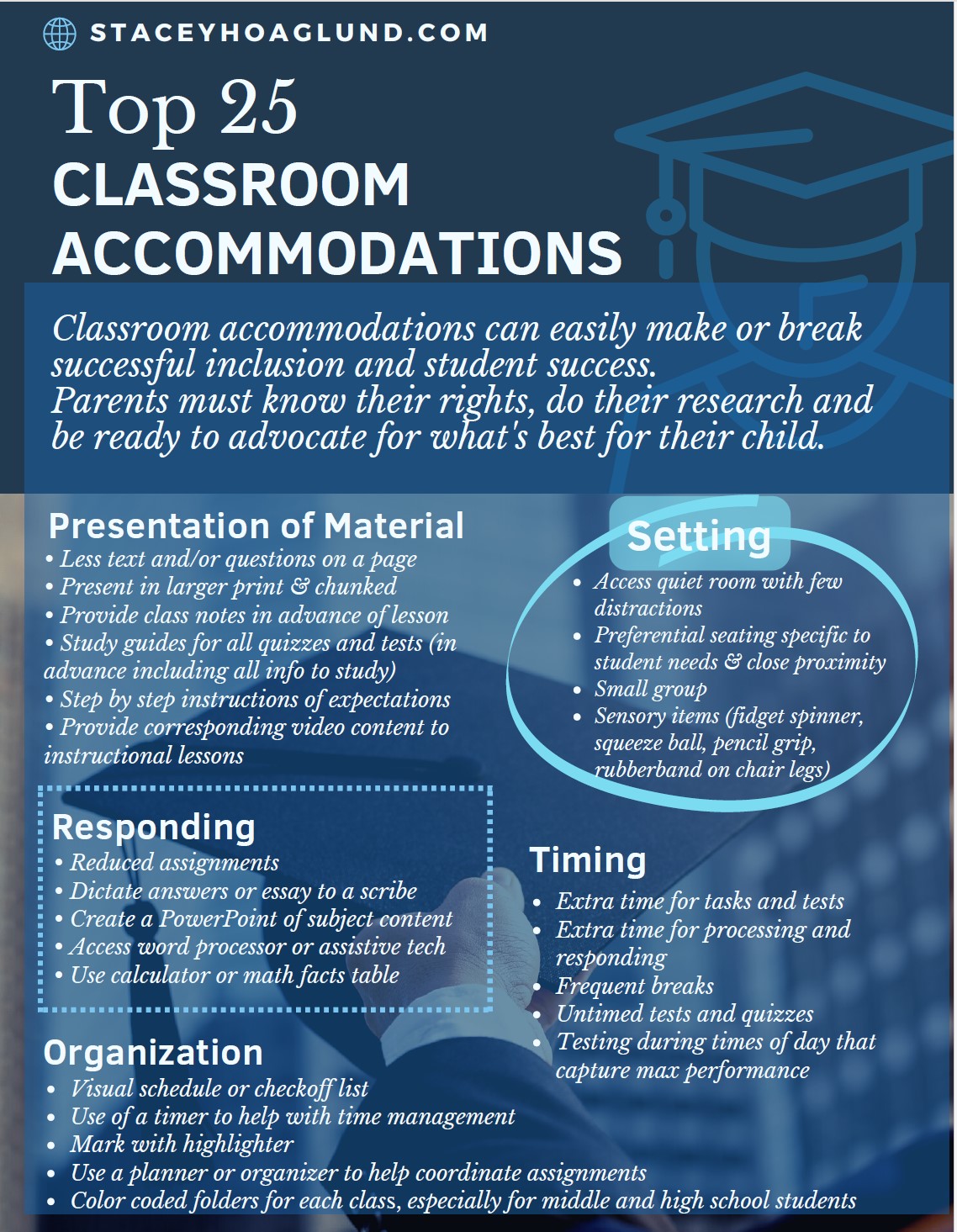
There is an accommodation section on each IEP. In some school districts it’s called Classroom Accommodations, in others it’s referred to as Supplementary Aids. Either way, these are the classroom accommodations that can and should be provided to help your child access their education. A few of the most important ones for high school, and these just so happen to be the same ones that some teachers tend push back against, are:

  • Class notes and study guides
  • Reduced assignments
  • Change class 3 minutes before the bell rings (for sensory kids)
  • Lessons broken down into smaller segments
  • Reporting/Collaborating with the parent (on a set schedule)
  • Peer assistance (setting up the student with good peer models)
  • Access to reference sheets for math

There’s tons more that are important, based on the needs of the student, but these are the ones that I find extremely helpful to high school students who are doing their education in regular classroom settings.

What Do You Do?

If you are one of the many parents out there who are being told that this is high school, things are different here, they're expected to be independent, that's not fair to give your child this accommodation when no one else gets it, that’s not the way things are done in high school, how is giving them notes preparing them for college, etc etc, know that the law is on your side. Schools are required to follow the IEP no matter if a particular teacher agrees with the accommodations on the plan or not. Same thing goes for the goals.

  • Read your IEP and look to see who the implementer is of the goals
  • Write those people a note and ask how the goals are being implemented in their classroom
  • If you see lack of progress, ask for data regarding the goals by the implementers. This is not the Progress Report that comes out quarterly. Ask for the raw data to show the growth or lack of growth on a weekly or monthly basis. I like graphed data, personally.
  • Ask the ESE specialist (LEA in most areas) if the teachers have been trained in following IEPs
  • Document your concerns if they continue

As in almost any field, when no one questions the status quo, most people end up feeling this is the way we've always done things, and this is the way things will continue. However, just because things have always been done a certain way, doesn't make it right. If you want your child to get the education that they deserve, with whatever support is necessary, then you must be actively engaged in their education. There is no way to ensure that your child receives a great education without your involvement.

Saturday, March 1, 2014

Monitoring Your Child's Education Through Observation


Monitoring your child’s education through observation

 
Now that half of the school year is behind us, it may be a good time for parents to schedule an observation of their child’s educational setting.  In order to be proactive in your child’s educational progress, it’s important to know what’s occurring during the time they’re at school.


Here are some tips for conducting observations:

·                     Look at your child’s schedule and decide which time would be most productive.  If your child does well during math, but struggles during reading or writing, you might want to schedule a time during the literacy block.  This will give you an opportunity to offer input that may assist the teacher during potentially difficult times for your child.

·                     Be prepared to give your child’s teacher at least 48 hours notice as to when you’d like to visit the classroom.

·                     When you arrive, try to sit in a location that’s nonintrusive to the children.  If the children are grouped at one side of the room, try to sit on the opposite side.  Make every attempt to sit facing your child’s back.  If your child sees you watching him/her, their behaviors may be altered.

·                     Be prepared to take notes.  During the observation is not the time to point out concerns that may come up.

·                     Do not engage with the teacher unless she initiates the conversation.  You are there to observe his/her interaction with the students and the instruction that your child is receiving.

·                     Some things to look for:

o   Is your child seated in an appropriate location to benefit from instruction?

o   Is your child receiving the necessary amount of adult support to be included within the setting and activity?

o   Are all assistive devices being utilized (postural supports, graphic organizers, communication devices, pencil grips, technology, etc)?

o   Is the room organized and can your child tell what the schedule and expectations are?

o   Is your child given opportunities to engage in the lesson?

·                     Give yourself a few days to think about what you observed, then schedule a time to review your notes with the teacher.

·                     Thank the teacher for her time and being accommodating to your presence.  When meeting with her, find at least two things that were positive about what you observed.  You want to keep your relationship with the teacher as positive as possible, while still advocating effectively for your child.